Everything That Happens Before the First Sprinkler Head Goes In: A Complete Guide to Irrigation Installation in Northern New Jersey
Most homeowners in the Pompton Plains, NJ, area do not think about irrigation until something goes wrong. The lawn starts browning in patches. The flower beds closest to the house are drowning while the ones near the property line are bone dry. The hose that was supposed to be a temporary solution three summers ago is still snaked across the patio.
By the time irrigation becomes a priority, the landscape has usually been underperforming for a while. And the instinct at that point is to move fast, get some sprinkler heads in the ground, and start watering. But irrigation installation done right is not a quick fix. It is a system designed around the specific conditions of the property, and the work that happens before a single head goes in determines whether the system performs well for years or creates a new set of problems.
In Northern New Jersey, where the soil types vary from heavy clay to sandy loam within the same county, where seasonal rainfall is unpredictable, and where municipal water restrictions are becoming more common, getting the system right from the start matters more than most homeowners realize.
Related: Sprinkler Repair in Ridgewood & Ho-Ho-Kus, NJ: Why Local Irrigation Demand Is Rising in 2026
Why a Hose or a Generic System Will Never Do What a Designed System Does
There is a reason professional irrigation installation exists as a distinct trade. Watering a landscape is not the same as distributing the right amount of water to the right zones at the right times. A hose gives you water where you point it. A generic system gives you water on a timer. Neither one accounts for the fact that your lawn, your perennial beds, your foundation plantings, and your shade garden all have different water requirements, different root depths, and different tolerances for too much or too little moisture.
A properly designed irrigation system treats each area of the property as its own zone, with its own schedule, its own precipitation rate, and its own head type selected for the coverage pattern and the plant material in that zone. That is the difference between watering and irrigating.
The Site Assessment: Where Every Good System Starts
Before any pipe is laid or any trench is dug, the property needs to be evaluated. This is the foundation of any irrigation installation that is going to perform correctly, and it covers more ground than most homeowners expect.
A thorough site assessment addresses four areas that each shape the final system design:
Water source evaluation, including the available pressure and flow rate from the main. This determines how many zones the system will need and how many heads can operate on each zone without losing pressure. A system designed beyond the capacity of the water source will have heads that barely mist instead of spraying, coverage gaps, and uneven distribution across the lawn.
Soil analysis to understand drainage behavior. In Northern New Jersey, properties in Morris County and parts of Passaic County often sit on heavy clay that holds water and drains slowly. Properties in parts of Bergen County and Somerset County may have sandier soils that drain quickly and require more frequent, shorter watering cycles. The soil type directly affects how the system is programmed and how the zones are configured.
Landscape inventory to catalog what is planted where and what each area needs. Turf areas require a different approach than shrub beds. Annual color beds need different moisture levels than established perennials. Trees with deep root systems need infrequent, deep watering. Shade gardens under mature canopy need less water than full sun areas. Every planting zone on the property has its own requirement, and the irrigation system needs to match it.
Physical layout mapping, including walkways, driveways, patios, structures, property lines, and grade changes. Are there slopes that will cause runoff if heads apply water too fast? Are there areas near the house foundation that need to stay dry? All of these factors shape where pipe runs, where heads are placed, and where the system needs to avoid.
Designing the System: Zones, Heads, and Distribution
Once the site assessment is complete, the design phase translates all of that information into a working plan. This is where the irrigation installation goes from concept to blueprint, and where the technical decisions are made that determine long term performance.
Zoning is the backbone of the design. Each zone groups together areas with similar water needs, similar sun exposure, and similar soil conditions. Mixing a full sun lawn zone with a shaded bed zone on the same circuit means one area gets too much water while the other gets too little. Proper zoning eliminates that problem.
Head selection varies by zone. Rotary heads are typically used for larger turf areas because they throw water in a slow, even arc that reduces runoff. Spray heads cover smaller, more defined areas like narrow strips of lawn, foundation beds, and garden borders. Drip irrigation is used for beds, containers, and areas where overhead spray would create waste or promote disease on plant foliage.
Each head is placed based on a concept called head-to-head coverage, which means the spray from one head reaches the next head in the circuit. This overlap is what creates uniform distribution. Without it, you get donuts of green turf around each head with dry spots in between.
The design also accounts for precipitation rate, which is how quickly the system applies water per zone. Matching the precipitation rate to the soil's ability to absorb water prevents runoff, pooling, and erosion, all of which are common on properties with clay soils or grade changes.
What the Installation Day Actually Looks Like
The physical installation of an irrigation system is where the plan meets the ground. For homeowners who have never been through the process, here is what to expect.
Trenching is the most visible part of the work. Pipes are typically buried 8 to 12 inches below the surface, deep enough to avoid damage from aeration, foot traffic, and light grading, but accessible enough for future repairs. In Northern New Jersey, the depth also needs to account for winterization, since any water left in shallow lines will freeze and crack the pipe.
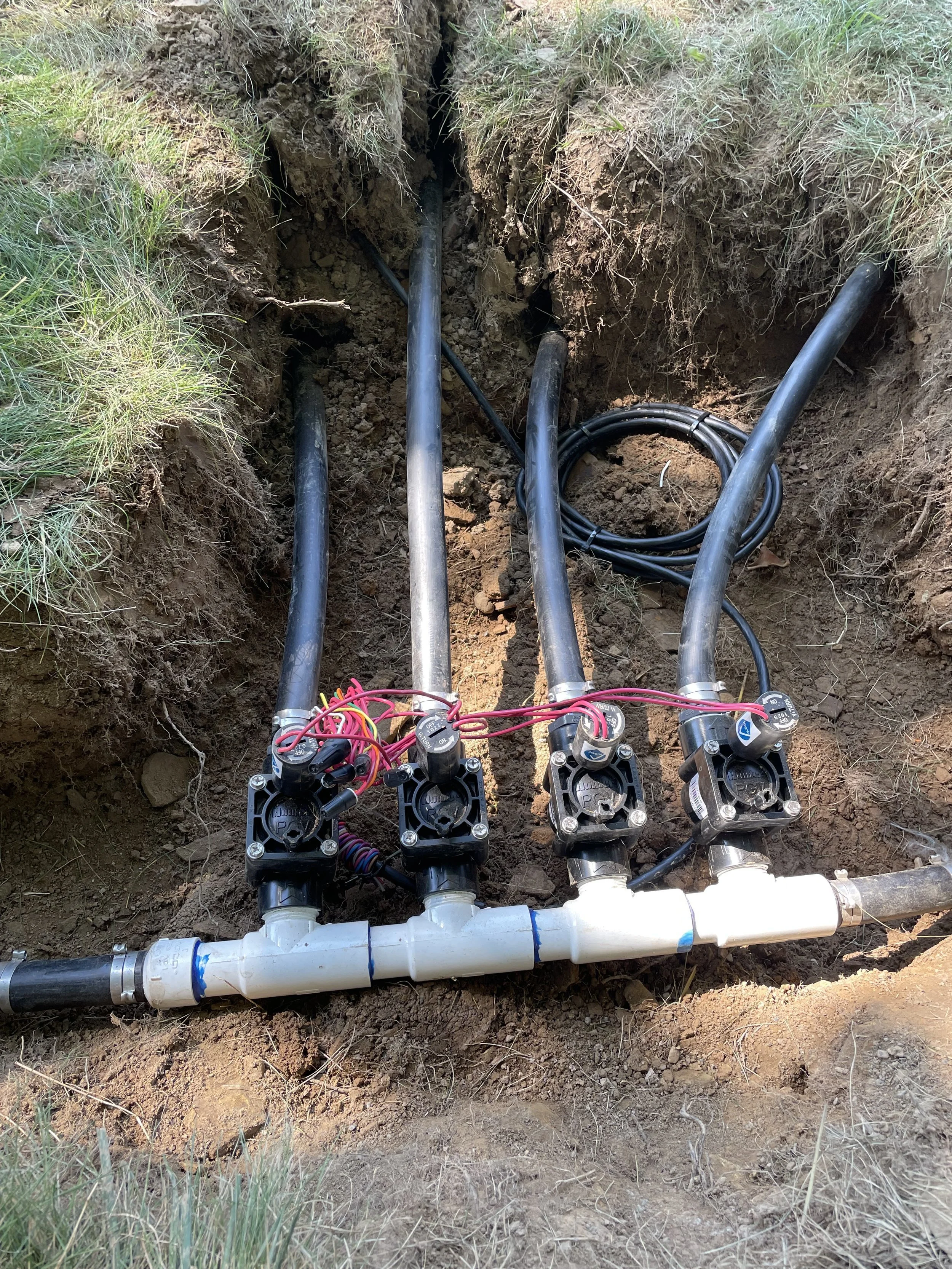
Main lines run from the water source to the valve manifold, which is the control center for the system. From the manifold, lateral lines branch out to each zone. Valves open and close on signal from the controller, directing water to one zone at a time.
Heads are installed at the end of each lateral line, positioned according to the design plan. Spray patterns are adjusted on site to account for actual conditions that may differ slightly from the plan, such as a tree branch that deflects spray or a slope that shifts the throw angle.
The controller is programmed with a schedule for each zone based on the plant material, the soil type, the sun exposure, and the season. Modern controllers offer weather-based adjustments that automatically reduce run times after rain and increase them during dry periods, which is particularly useful in New Jersey where summer rainfall can be heavy one week and absent the next.
Once the system is pressurized and tested, each zone is run individually to verify coverage, check for leaks, and make final adjustments to head arcs and spray distances. This is not a step that should be rushed. A system that is tested thoroughly on install day will require far less troubleshooting down the road.
The Mistakes That Turn a Good System Into an Expensive Problem
Even when the design and installation are done correctly, a handful of common errors can undermine the entire investment. Understanding these pitfalls is part of understanding what makes a professional irrigation installation worth the cost.
Overwatering is the most frequent issue. Homeowners who are not familiar with how their system works often set the controller to run every day, assuming more water means a healthier lawn. In reality, daily shallow watering encourages grass roots to stay near the surface, making the turf weaker and more vulnerable to heat stress and disease. Deep, infrequent watering produces stronger root systems and healthier turf across all of the common grass types grown in Northern New Jersey, including Kentucky bluegrass, perennial ryegrass, and fine fescue blends.
Ignoring seasonal changes is another common problem. A system that runs the same schedule in May as it does in August is wasting water during the cooler months and potentially starving the lawn during peak summer demand. The best systems use smart controllers with weather based adjustments, but even those need periodic review to ensure the sensors are functioning and the programming reflects any changes to the landscape.
Neglecting head maintenance also degrades performance over time. Heads that are tilted by mower traffic, buried by mulch, or partially clogged by sediment will throw uneven patterns that create dry spots and wet spots across the same zone. A system that looked perfect on install day can drift out of alignment within a season if heads are not checked and corrected regularly.
These are not design failures or installation failures. They are maintenance failures, and they are entirely preventable with a seasonal service program.
What Happens After the System Is In
A properly installed irrigation system is not a set it and forget it feature. It requires seasonal adjustment and periodic maintenance to continue performing at the level it was designed for. In Northern New Jersey, where the growing season spans roughly April through October and winter brings hard freezes, a year-round service cycle typically includes:
Spring activation and full zone inspection to identify heads damaged by frost heave, shifted by snow removal equipment, or clogged by debris over the winter. The controller schedule is reset from its winterized state to match early-season watering needs, which are typically lighter than midsummer.
Midsummer schedule adjustments as heat and demand increase. A controller running the same program in April that it runs in July is either overwatering early in the season or underwatering during peak demand. Properties in USDA Zone 6b, which covers most of Northern New Jersey, experience enough seasonal variation that static programming simply does not work well.
Fall scale back as the growing season slows and plant water demand decreases. This is also the time to inspect for any head or valve issues that developed during the high use months.
Winterization before the first hard freeze, which involves blowing compressed air through every line and head to remove all standing water. This step is critical. A system that is not properly winterized in this climate will have cracked pipes, broken fittings, and damaged valves that will not become apparent until the system is turned on the following spring.
Each of these seasonal touchpoints is an opportunity to catch small problems before they become expensive repairs. A head that is slightly off arc in June becomes a dead spot in the lawn by August. A valve that is slow to close in September becomes a flooded zone in October. The system performs best when someone who understands it is checking it regularly.
Why Irrigation Installation Should Happen Alongside the Landscape, Not After It
One of the most common and most costly mistakes homeowners make is installing the landscape first and the irrigation system later. This forces the irrigation contractor to work around established plantings, hardscape, and root systems that would not have been in the way if the two projects had been coordinated from the start.
When irrigation installation is planned and executed as part of the overall landscape project, the pipe runs are cleaner, the head placement is more precise, the zones align with the actual planting plan, and the system integrates with the hardscape without visible lines, exposed valves, or heads placed in awkward locations.
It also avoids the damage that comes with trenching through a finished landscape. Cutting through an established lawn to lay pipe means tearing up turf that then needs to be repaired. Running lines under a paver patio or walkway after it has already been set requires pulling up sections and resetting them. These are avoidable costs that add up quickly, and they are the direct result of treating irrigation as an afterthought instead of a core component of the landscape plan.
The result is a system that works better, looks better, and costs less to maintain over time.
The System Should Work So Well You Forget It Is There
The best irrigation systems are invisible. The lawn is green. The beds are healthy. The water bill is reasonable. And the homeowner does not have to think about it because the system was designed for the property, installed correctly, and maintained through every season.
If your property in Northern New Jersey does not have an irrigation system, or if the one you have is underperforming, patched together, or creating more problems than it solves, we are happy to come take a look at the site and talk through what a system designed for your specific landscape would involve.
Related: Creating Beautiful Outdoor Spaces With Landscape Design and Plantings in Oakland, NJ