
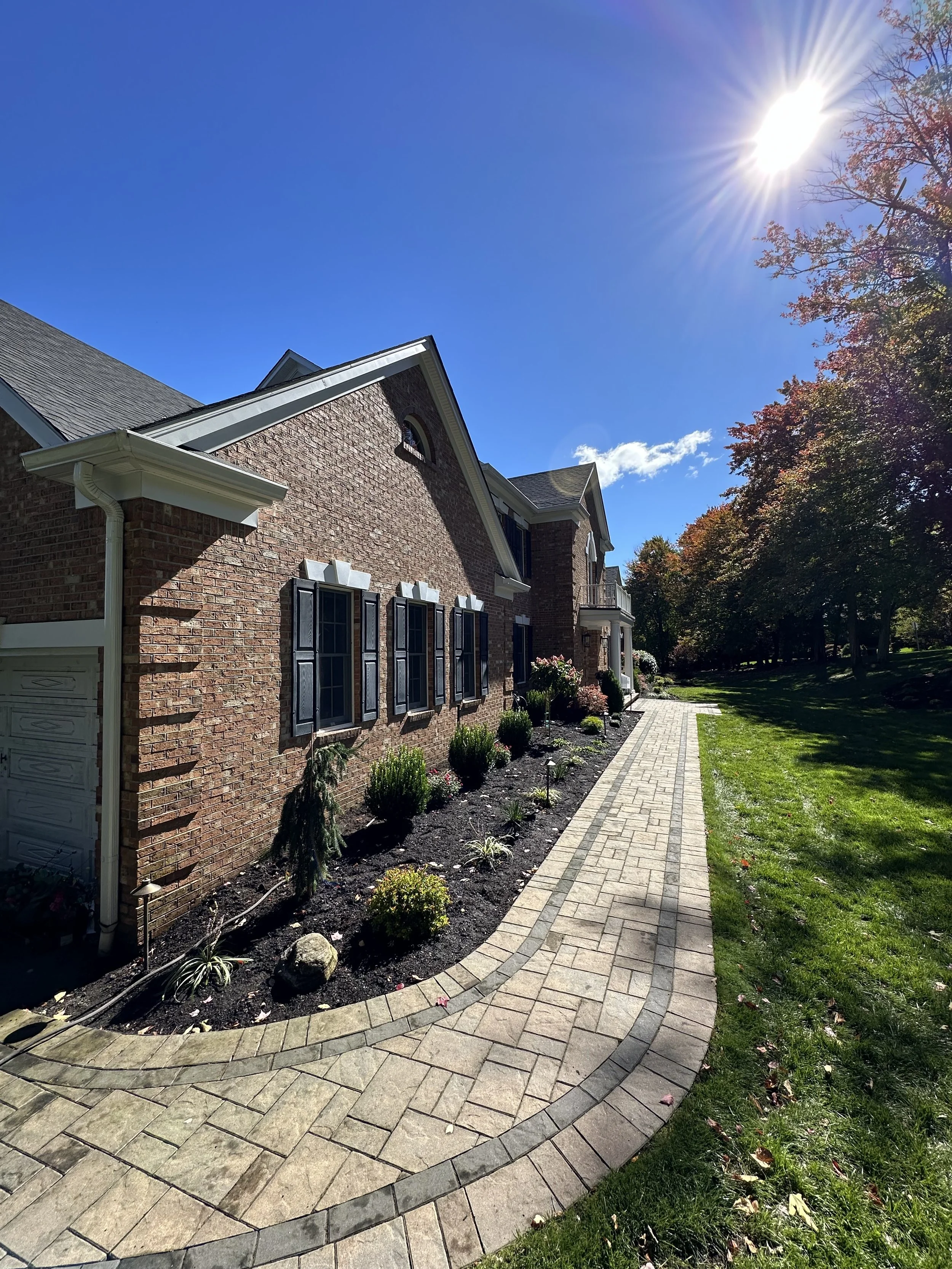
October is when most homeowners stop thinking about the lawn and when lawn care services in Pompton Plains, NJ are doing the work that matters most. Cool-season turf is putting energy into roots rather than blades, soil is still warm, air is cooling, and what happens in this window decides what the property looks like in May.
Green Nature is owned and operated by Elvis and Neno, who bring more than 30 years of hands-on experience designing and building outdoor spaces throughout New Jersey. Across Morris, Bergen and Essex counties, the lawns that look effortless in spring are reliably the ones somebody treated properly the previous fall.
This guide follows a northern New Jersey lawn through a full treatment program: what each application is for, why timing beats product choice, and how a program is adjusted to a specific property rather than run from a calendar.
Related: Eco-Friendly Lawn Care in Wayne and Pequannock, NJ: Organic Treatments for Healthier Grass
Why Does a Lawn Care Program Beat Individual Treatments?
A lawn care program beats individual treatments because turf responds to a sequence rather than to an event. A fertilizer application lands on soil that was prepared, or it does not, and a pre-emergent works only if it went down before germination. Each step either sets up the next one or arrives too late to matter.
We apply services based on the season and the condition of the lawn, which is a different approach from running the same products across every property on the same week. Two lawns a mile apart often need different timing because of shade, soil and slope.
The cumulative effect is what homeowners notice. A lawn under a program for three seasons has a thicker sward, deeper roots and fewer weeds, and it needs less intervention each year rather than more, because the program is built to compound rather than to repeat.
What Does Each Lawn Treatment Application Do?
Each application in a season has a distinct job, starting with early spring fertilization, which feeds the first flush of growth without pushing it. Too much nitrogen too early produces soft top growth at the expense of roots, which is exactly the wrong preparation for a New Jersey July.
Pre-emergent goes down in the same window and works by preventing crabgrass seed from establishing. Timing is set by soil temperature rather than by date, and a week late is the difference between a clean lawn and one that needs spot treatment all summer.
Mid-season applications shift to balanced feeding and selective broadleaf control. Dandelion, clover, plantain and the rest are treated when they are actively growing, which makes the products more effective and the quantities smaller.
Late season is the most valuable feed of the year. Applied as top growth slows, it goes into root development and carbohydrate storage, and it is the single application that most affects spring green-up.
Why Does Treatment Timing Matter More Than Product Choice?
Treatment timing matters more because most professional turf products are effective at the right moment and close to useless at the wrong one.
A pre-emergent applied after germination does not undo what has already happened, and a broadleaf product applied in a heat wave stresses the turf more than the weed.
That is the real argument for a program over a trip to a store. The decision being bought is when, not what, and it is a decision made by somebody watching the soil rather than the calendar.
What Does Northern New Jersey Lawn Soil Need?
Northern New Jersey lawn soil mostly needs air. Soils through this part of Morris and Bergen counties tend toward heavy, and heavy soil compacts, starving roots of oxygen long before anything shows on the surface. That is why a lawn fed correctly all year still thins out.
Core aeration is the mechanical answer, and nothing substitutes for it. Pulling plugs opens channels for air, water and nutrients, and on heavier ground doing it annually is ordinary rather than optional.
pH deserves periodic attention too. Soils here trend acidic, and turf sitting outside its preferred range does not take up nutrients efficiently regardless of how much is applied. A soil test every few years answers a question that guessing does not.
When Should Lawn Aeration and Overseeding Happen in New Jersey?
Lawn aeration and overseeding belong in late summer into early fall, together and in that order. Cool-season grasses are directing energy to roots in that window, soil is warm enough for germination and air is cool enough to reduce stress on new seedlings.
Seed dropped into open aeration holes has soil contact, moisture retention and protection from being washed away, which is why the two operations belong in the same visit. Overseeding onto an unaerated surface puts most of the seed where it will not germinate.
Spring is the weaker alternative and sometimes the necessary one. New seedlings in spring face summer heat before their roots are deep, and any pre-emergent applied for crabgrass also prevents grass seed from establishing. Our crews say plainly which trade-off a given property is making.
What Does Mowing Decide That Lawn Products Cannot?
Mowing decides more about lawn quality than any application on the schedule. Mowing height sets how much leaf area the plant retains, and leaf area is how grass makes energy, so cutting high through summer shades the soil, slows moisture loss and keeps the crown out of direct heat.
Frequency matters alongside height. Removing more than about a third of the blade at once shocks the plant and forces it to spend reserves recovering, which is why a lawn cut rarely and hard looks worse than one cut often and lightly.
Blade sharpness is the detail nobody sees. A dull blade tears rather than cuts, leaving a ragged edge that browns and offers an entry point for disease. On a lawn that looks generally tired for no obvious reason, this is worth checking before anything is applied.
What Does Lawn Disease Pressure Look Like in Northern New Jersey?
Lawn disease pressure in northern New Jersey follows humidity rather than neglect. A stretch of warm nights and heavy dew in July is enough for disease to move through a cool-season lawn in days, and the first sign is usually a shape rather than a color: rings, irregular blotches, or a straw patch that was fine on Friday.
Reading the shape matters because drought stress, insect damage, dull blades and disease all produce browning and call for four different responses. Treating the wrong one costs a season, since the real cause keeps working while the lawn recovers from something it did not have.
Prevention is largely cultural. Watering early in the morning rather than in the evening, mowing high, keeping blades sharp and avoiding heavy nitrogen during a heat wave remove most of the conditions disease needs.
How Should a Lawn Be Watered in Northern New Jersey?
A northern New Jersey lawn should be watered deeply and infrequently. Short daily cycles keep the surface damp and train roots to stay shallow, which is the opposite of what a lawn needs going into August, while longer, less frequent cycles push water down and roots follow it.
Heavy soil changes the method rather than the principle. Water applied faster than the ground absorbs it runs off, so the same total volume delivered in two or three shorter cycles with gaps between them actually reaches the root zone.
Morning is the window. Watering in the evening leaves foliage wet overnight through exactly the humid conditions disease wants, and watering at midday loses a meaningful share to evaporation before it lands.
Related: From Dull to Lush: Professional Lawn Care Services in Short Hills and Towaco, NJ
What Changes for Lawn Care on a Shaded or Sloped Property?
On a shaded or sloped property, seed selection changes first. Fine fescues tolerate shade in a way that ryegrass does not, so the overseed mix under a mature canopy differs from the mix on an open front lawn, and running one blend across a whole property produces the patchy result homeowners call about.
Slopes change the water story. Rainfall and irrigation both run off a slope before soaking in, so the turf at the top of a bank is drier than the lawn at the bottom even on a well-watered property, and the two want different schedules.
Trees take their share regardless. An established oak or maple draws water and nutrients from well past its canopy edge, and grass underneath is competing rather than failing, so adjusting expectations there is often more useful than adjusting products. Our plantings work is planned around that competition rather than against it.
What Should Happen to Fall Leaves on a Lawn?
Fall leaves on a lawn should be managed rather than ignored or simply blown off. A heavy mat left over a wet week smothers turf, blocks the light the grass still needs in October and creates the damp, airless conditions that invite disease going into winter.
On a property with a dozen mature trees that mat builds between two scheduled visits, which is why wooded properties carry more leaf visits than open lots and why the schedule says so in advance rather than being adjusted on the day.
Some leaf material is useful when the mower processes it. Mulching light leaf fall back into the lawn returns organic matter and feeds soil biology, and it works well up to a point. Past that point the volume is simply too great and removal is the honest answer.
Why Does the Last Mow of the Season Matter?
The last mow of the season matters because it sets the lawn’s height for winter. It is cut slightly lower than the summer height, which reduces the amount of leaf matting down under snow and lowers the risk of snow mold appearing in a wet March.
Lower does not mean scalped. Taking the lawn down too far removes the crown protection it needs through winter, and the recovery in spring is slow. The adjustment is modest, and it is one of the small decisions that separates a maintained lawn from a mown one.
How Do Planting Beds and Lawn Affect Each Other?
Planting beds and lawn affect each other constantly, and mostly at the edge. Turf creeps into mulch, bed soil washes onto turf, and the line between them blurs within a season if nobody maintains it, while a cut edge holds that line, gives a mower something to run against and makes the whole property read as cared for.
Weed pressure moves across the boundary in both directions. A bed left to seed feeds the lawn beside it, and broadleaf weeds in turf colonize an open mulch surface given the chance, so treating the two as one system is more effective than treating either alone.
Mulch depth matters to the lawn as well as the bed. Mulch piled too deep sheds water rather than holding it, and the runoff goes somewhere, usually onto the turf immediately downhill, where it carries fines that seal the surface.
How Does Irrigation Interact With a Lawn Care Program?
Irrigation interacts closely with a lawn care program, and badly when nobody checks. A system programmed for a newly seeded lawn is wrong for the same lawn two years later, and heads get knocked, sink below grade or disappear into shrubs that have grown around them.
A zone that has lost coverage produces a dry arc that looks like a fertility problem and gets treated as one. Running every zone and watching it operate takes an hour and answers a question that no amount of product will.
Scheduling should move with the season rather than hold a fixed pattern. A controller that tracks rainfall and adjusts run times does far more for turf quality than an extra application does, which is why our residential irrigation team checks the zones the turf program depends on.
What Should a Homeowner Expect in Year One of a Lawn Care Program?
A homeowner should expect improvement rather than transformation in year one. A lawn taken on in poor condition is recovering through its first full season, and the visible gains tend to arrive in the spring after the first fall program rather than in the summer it started.
Weed pressure usually falls first, because selective control works quickly and visibly. Density takes longer, since it depends on aeration, overseeding and a root system that has to be built over a season.
Honest expectations are part of the service. Our crews say which results belong to this season, which belong to the next, and which are asking more of a lawn than its soil or its shade will allow, and that candor is part of why homeowners choose Green Nature in the first place.
Book Fall Lawn Care Services in Pompton Plains, NJ While the Soil Is Warm
The work that decides a spring lawn happens in a window that closes quietly, and most homeowners notice it has gone only when the following May disappoints them.
Our team would rather walk the property now, check what the soil is doing and set the late-season schedule while it still counts.
Start your lawn care program in Pompton Plains, NJ with Green Nature. Schedule your lawn care consultation with Green Nature.
In Summary
How late in the year can overseeding still work in Pompton Plains, NJ?
Overseeding in Pompton Plains, NJ works until soil temperatures fall too low for germination, so the window closes with the soil rather than on a fixed date. Seed sown too late germinates thinly or not at all and sits until spring, where much of it is lost. Our crews read soil temperature rather than the calendar and say honestly when a property has missed the window.
Is a lawn care program worth it on a heavily shaded property?
A lawn care program keeps a heavily shaded lawn healthy, but it will not give it the density of one in full sun. Shade limits what turf achieves regardless of inputs, and on some properties the better answer is adjusting expectations, changing the seed mix, or converting the most difficult areas to beds.
How many visits does a full-season lawn care program usually include?
The number of visits in a Green Nature lawn care program follows the property rather than a standard count, because shade, soil, slope and existing condition all change what is needed. What matters more than the count is that the visits land in the right windows, particularly the pre-emergent timing in spring and the aeration and overseeding window in late summer.
Related: Premier Lawn Care Strategies for Homeowners in Short Hills and Ho-Ho-Kus, NJ
